
TL;DR:
- Implement lifecycle policies to automatically tier video files and save up to 95% on storage costs.
- Choose cost-effective cloud providers like Backblaze B2 for significant savings on storage and egress fees.
- Compress videos using advanced codecs like HEVC before upload to drastically reduce storage requirements and costs.
Cloud storage bills have a way of sneaking up on content creators and small businesses. You start with a few gigabytes of 4K footage, and before long you're staring at a monthly invoice that rivals a car payment. Storing 1TB in AWS S3 can cost over $23 per month at standard rates, but cold storage alternatives can be more than 95% cheaper. The good news is that a handful of smart, research-backed strategies can slash those bills dramatically without sacrificing your workflow or video quality. Here's exactly how to do it.
Table of Contents
- 1. Use lifecycle policies to tier your video files
- 2. Switch to cost-effective cloud providers
- 3. Compress videos with advanced codecs before upload
- 4. Set up smart file management and deletion rules
- 5. Compare and combine strategies for maximum savings
- Why most creators waste money on cloud—and how you can do better
- Get started: Tools to compress and manage your video storage today
- Frequently asked questions
Key Takeaways
| Point | Details |
|---|---|
| Automate file tiering | Lifecycle policies can reduce cloud storage costs by as much as 95% for archived video. |
| Choose smarter providers | Switching from AWS S3 to Backblaze B2 or alternatives can yield 80–94% savings on large media archives. |
| Compress before uploading | Advanced codecs like HEVC can shrink your storage footprint by 70% with minimal quality loss. |
| Combine cost-saving strategies | Stacking tiering, smart provider selection, and compression leads to maximum savings. |
1. Use lifecycle policies to tier your video files
Lifecycle policies are automated rules that move your files between storage classes based on how often you access them. Think of it like a filing cabinet: your most-used footage stays on your desk (Standard storage), while older projects get boxed up in the basement (Deep Archive). The cloud does the sorting for you, automatically.
The cost difference is staggering. Cloud lifecycle policies can cut video storage costs by 95% by tiering files from Standard at $0.023 per GB down to Deep Archive at $0.00099 per GB. For a real-world example, 10TB of footage in Standard storage costs around $235 per month. Move that same content to Deep Archive and you're paying roughly $10 per month. That's a saving of over $2,700 per year on a single storage bucket.
Before you set up transitions, understand the caveats. AWS S3 Glacier and similar deep archive tiers carry a 90-day minimum charge, meaning you'll pay for at least three months even if you delete a file early. Retrieval can also take hours, so these tiers are best for footage you rarely need back fast.
Here's a simple framework for deciding where each file belongs:
- Hot (Standard): Active projects, files accessed weekly or more.
- Warm (Infrequent Access): Completed projects accessed a few times per year.
- Cold (Glacier or equivalent): Finished work kept for compliance or long-term backup.
- Deep Archive: Raw footage or masters you almost never need to retrieve.
"The biggest mistake creators make is leaving everything in Standard storage by default. One lifecycle rule can pay for itself in the first month."
Pro Tip: Pull your cloud access logs before configuring transitions. Most providers show you exactly when each file was last accessed, so you can set transition timelines based on real data rather than guesswork. Pair this with lifecycle cost-saving tips and storage management tips to build a system that runs itself.
2. Switch to cost-effective cloud providers
Once your files are tiered, cutting costs can be as simple as choosing a smarter provider. Not all cloud storage is priced the same, and for video archives in particular, the difference is massive.
Here's a quick comparison of the major players in 2026:
| Provider | Storage cost per GB/mo | Egress cost per GB | 1TB store + 1TB egress |
|---|---|---|---|
| AWS S3 Standard | $0.023 | $0.09 | ~$104 |
| Google Cloud Storage | $0.020 | $0.08 | ~$92 |
| Azure Blob Storage | $0.018 | $0.087 | ~$90 |
| Backblaze B2 | $0.006 | $0.01 | ~$16 |
Backblaze B2 offers $0.006/GB/mo compared to AWS S3 at $0.023/GB/mo, which works out to roughly 94% savings on a combined storage and egress scenario. For a small business storing 10TB of video archives, that gap translates to thousands of dollars annually.
That said, provider choice isn't purely about the lowest number on the pricing page. Consider these factors:
- Reliability: AWS and Google have near-perfect uptime records. Backblaze B2 is solid but has a smaller global infrastructure.
- Egress fees: This is where many creators get burned. Moving data out of AWS is expensive. Backblaze B2 has dramatically lower egress costs and partners with Cloudflare for free egress in some setups.
- Integration: If your editing tools or CDN already connect to S3, switching providers adds migration work upfront.
- Support: Enterprise-level support costs extra on most platforms.
Pro Tip: Always calculate your total cost including egress, not just storage. A cheaper storage rate means nothing if you're pulling footage regularly and paying premium bandwidth fees. Explore the advantages of cloud file storage for each provider before committing. A cost-effective storage workflow will account for both sides of the equation.
3. Compress videos with advanced codecs before upload
Not all cost savings happen in the cloud itself. Compression is your secret weapon before upload. If you're sending raw or minimally compressed footage straight to the cloud, you're paying to store a lot of data you don't need.

HEVC (H.265) is the current gold standard for high-efficiency video compression. Compared to older H.264 encoding, HEVC delivers the same visual quality at roughly half the file size. HEVC encoding can cut video file size by up to 70%, directly reducing your cloud storage footprint and cost. That means 1TB of raw 4K footage could compress down to around 300GB before it ever touches your cloud bucket.
Here's what a smart pre-upload compression workflow looks like:
- Batch convert all finished or archived projects using an HEVC encoder before uploading.
- Keep your working files in a lossless or high-bitrate format locally while editing.
- Upload compressed versions for storage, delivery, or backup once a project is complete.
- Use AV1 for web-facing content where browser compatibility is strong and you need even smaller files.
- Avoid re-encoding the same file multiple times, as each pass can introduce quality loss.
70% file size reduction = 70% lower storage bill. If you're storing 50TB of video, that's potentially 35TB you never have to pay for.
Pro Tip: Before converting your entire library, run a single test file through HEVC compression and compare the output quality side by side with the original at full resolution. Most creators are surprised how little quality is lost at significant size reductions. Check out advanced video compression strategies to find the right settings for your content type.
4. Set up smart file management and deletion rules
No strategy works without good management. Cloud clutter is one of the most overlooked sources of wasted spend, and it builds up faster than most creators realize.
Versioning is a common culprit. When you enable versioning on a cloud bucket (which is often recommended for safety), every saved change creates a new copy. Without limits, a single project folder can balloon into dozens of versions, each one costing money. Automated rules can stop old versions and forgotten files from accumulating costly charges even in lower-priced storage classes.
Here's a step-by-step approach to setting up smart deletion rules:
- Enable versioning with limits: Set a maximum version count (e.g., keep only the last 3 versions of any file).
- Set TTL (time-to-live) policies: Automatically delete files after a defined period, such as raw uploads older than 180 days.
- Tag files by project status: Use labels like "active," "complete," or "archive" to trigger different rules per category.
- Schedule quarterly reviews: Automate a monthly report of your largest and oldest files so nothing hides in a forgotten folder.
- Delete orphaned files: Rendered previews, temp exports, and test encodes often get left behind. Set rules to clean these automatically.
"Cloud storage is like a garage. If you never throw anything out, eventually you're paying for a storage unit just to hold things you forgot you had."
This kind of proactive management often saves more than archiving alone, because it eliminates costs entirely rather than just reducing them. A solid storage saving guide and smart video management system work together to keep your cloud lean year-round.
5. Compare and combine strategies for maximum savings
With the strategies covered, it's time to see how they stack up and work even better together. Each approach has a sweet spot depending on your use case.
| Strategy | Best for | Estimated savings |
|---|---|---|
| Lifecycle tiering | Large archives, long-term projects | Up to 95% |
| Provider switch | High-volume storage, infrequent access | Up to 94% |
| HEVC compression | All video types before upload | Up to 70% |
| File management rules | Active workflows with frequent updates | 20-40% |
| Combined approach | Any serious video business | 90%+ |
Combining tiering, provider choice, and compression can reduce ongoing cloud costs by 90% or more for many creators. The math compounds quickly when you stack these techniques.
Here's how layering works in practice:
- A solo content creator with 5TB of YouTube footage benefits most from HEVC compression plus a Backblaze B2 migration for archives.
- A small agency managing client deliverables and raw files should prioritize lifecycle tiering on AWS plus strict deletion rules to control versioning bloat.
- A video production company with 50TB or more gains the most by combining all five strategies, starting with compression before upload and ending with automated lifecycle rules.
The key insight is that no single strategy does everything. Compression reduces what you store. Tiering reduces what you pay per GB. Provider choice reduces the baseline rate. File management prevents waste from creeping back in. Explore video storage costs explained to model your own scenario and find the right combination for your workflow.
Why most creators waste money on cloud—and how you can do better
Here's the uncomfortable truth: most content teams overspend not because they lack information, but because optimization requires upfront effort that feels optional when you're busy shipping content. Convenience wins. You pick the default storage class, skip the lifecycle setup, and upload raw files because it's faster right now.
The problem is that cloud storage costs compound silently. A few hundred dollars in waste this month becomes thousands by year-end. And because the bill arrives automatically, it rarely triggers the same alarm as a large one-time purchase.
The real shift happens when you treat storage like a production cost rather than a utility. That means learning your actual access patterns, not guessing. It means spending two hours setting up lifecycle rules that run automatically for years. It means compressing footage before upload becomes a non-negotiable step in your export process.
We've seen creators cut their monthly cloud bill by 80% in a single afternoon just by compressing their archive and switching providers. The tools exist. The savings are real. The only thing standing between you and a dramatically lower bill is the decision to stop defaulting to whatever is easiest and start building a system that works for your budget.
Reassess your storage setup every quarter. Access patterns change, projects end, and new footage accumulates. A quarterly review keeps savings from eroding over time.
Get started: Tools to compress and manage your video storage today
Ready to apply these strategies? The fastest way to start saving is to see exactly how much your current video files are costing you and then compress them before they hit the cloud.
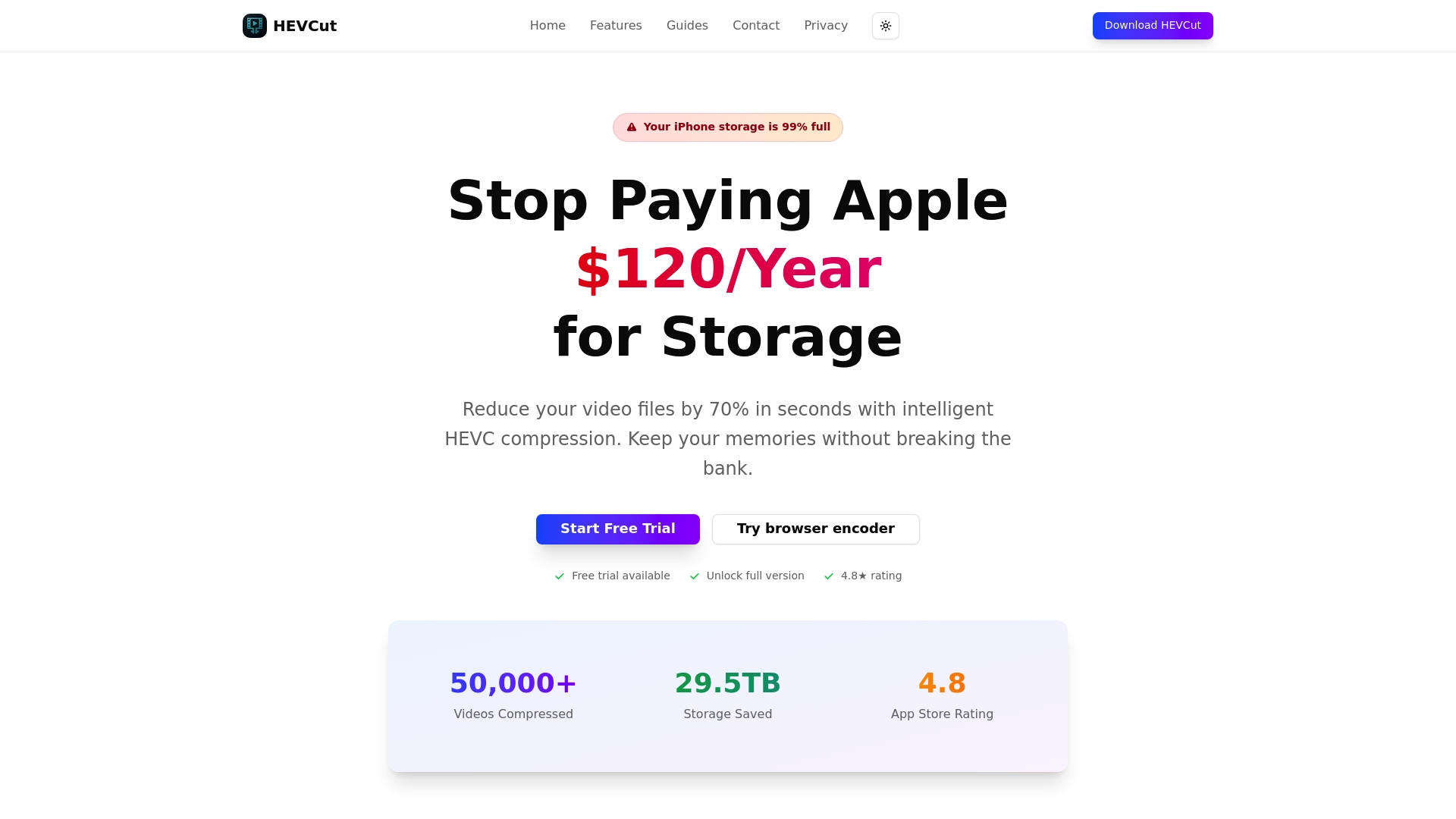
The HEVCut platform is built specifically for content creators and small businesses who need to reduce video file sizes without sacrificing quality. Use the video size calculator to estimate your current storage footprint and potential savings, then run your files through the video compressor to apply HEVC compression before your next upload. HEVCut supports batch processing, so you can compress an entire archive in one session. Start with a free trial and see the difference before committing.
Frequently asked questions
What is the cheapest cloud storage for video creators in 2026?
For large archives, Backblaze B2 at $0.006/GB/mo is among the most affordable options available, but always compare cold storage tiers from AWS and Google for your specific access patterns before deciding.
How much can compression actually save on cloud storage?
Advanced codecs like HEVC can reduce video file sizes by up to 70% without major quality loss, which means a direct and proportional reduction in your monthly storage bill.
Are there any downsides to using cold storage or Deep Archive tiers?
Cold storage is very cheap, but S3 Glacier and GCP Coldline carry 90-day minimum retention charges and slow retrieval times, making them a poor fit for footage you access regularly.
What's the best way to automate cloud file cleanup?
Set versioning limits and automated deletion rules to prevent old drafts, temp files, and orphaned exports from quietly inflating your bill month after month.