
Managing high-resolution video files can drain your storage budget fast. Whether you're shooting 4K content for clients or archiving HDR footage for future projects, the costs add up quickly. Cloud subscriptions climb month after month, external drives pile up, and you're left wondering if there's a smarter way to handle your growing video library. The good news? There are proven strategies that can cut your storage expenses dramatically without sacrificing the quality your audience expects. This guide walks you through the most effective cost-saving storage approaches for 2026, from choosing the right storage mix to leveraging advanced compression technologies that can reduce file sizes by up to 70%.
Table of Contents
- Criteria for choosing cost-saving storage solutions
- Top cost-saving storage options for high-resolution videos
- How advanced video compression slashes storage costs
- Comparing storage solutions and strategies: which saves you the most?
- Save on video storage with HEVCut tools
- FAQ
Key takeaways
| Point | Details |
|---|---|
| Compression cuts costs | Advanced video compression reduces storage needs by up to 70% without visible quality loss. |
| Storage workflow matters | Combining cloud and local storage balances cost, accessibility, and scalability effectively. |
| Regular file management | Archiving inactive files and cleaning up duplicates prevents unnecessary storage expenses. |
| Specialized tools help | Dedicated compression and calculation tools streamline optimization and improve cost efficiency. |
| Balance quality and savings | Smart codec selection and adjustable settings maintain viewer experience while reducing costs. |
Criteria for choosing cost-saving storage solutions
Before diving into specific storage options, you need a clear framework for evaluating what will actually save you money. Start by defining your budget constraints and quality requirements. If you're shooting high-end commercial work, your quality threshold differs from someone creating social media content. Understanding this baseline helps you avoid overspending on unnecessary features or cutting corners that hurt your final product.
Next, evaluate storage types based on key factors including compression efficiency, storage type costs, access speed, scalability, and data security. Cloud storage offers convenience and automatic backups but charges recurring fees that escalate with usage. Local storage like HDDs or NAS systems requires upfront investment but eliminates monthly bills. Hybrid approaches give you flexibility to optimize costs by storing active projects in the cloud while archiving completed work locally.
Consider these essential criteria:
- Scalability potential: Can the solution grow with your video library without exponential cost increases?
- Access speed requirements: Do you need instant access to all files, or can some live in slower, cheaper storage tiers?
- Data security and backup reliability: What happens if a drive fails or cloud service has an outage?
- Maintenance overhead: How much time and technical skill does the solution require?
- Long-term value: Does the solution save money now but create problems later?
Pro Tip: Calculate your total cost of ownership over three years, not just the initial price. A $200 external drive might seem cheaper than cloud storage, but factor in backup drives, potential failures, and your time managing files.
Balance immediate savings against long-term value. The cheapest option today might cost more tomorrow if it can't scale, requires constant manual intervention, or puts your files at risk. Building a cost-effective video storage workflow means thinking strategically about how your needs will evolve.
Top cost-saving storage options for high-resolution videos
Once you understand your evaluation criteria, you can assess specific storage solutions that fit your workflow and budget. Each option carries distinct advantages and trade-offs that affect your bottom line differently.
Cloud storage platforms like Google Drive, Dropbox, or specialized media services provide flexibility and automatic synchronization across devices. You can access files anywhere with internet, and most services handle backups automatically. However, costs scale with usage. A terabyte might start at $10 monthly, but heavy video creators can quickly need 5-10TB, pushing monthly bills past $100. These recurring expenses add up to thousands annually.
Local storage options offer different economics. External HDDs provide massive capacity at low per-gigabyte costs, with 8TB drives available under $200. SSDs cost more but deliver faster access speeds crucial for editing. NAS systems let you build a personal cloud at home, combining multiple drives with RAID protection and network access. The catch? You handle maintenance, replacements, and backups yourself.

Hybrid solutions represent the sweet spot for many creators. Combining cloud services with local storage offers both cost savings and accessibility. Keep active projects in the cloud for easy collaboration and device syncing. Move completed projects to local drives for long-term archival. This approach minimizes monthly cloud fees while maintaining convenient access to current work.
Cold storage options deserve attention for files you rarely access. Amazon Glacier and similar services charge pennies per gigabyte for archival storage, perfect for finished projects you need to keep but won't touch for months. Retrieval takes hours instead of seconds, but the cost savings are substantial for large archives.
Consider these storage combinations:
- Active projects: Fast SSD or cloud storage for immediate editing needs
- Recent completions: Standard HDD or mid-tier cloud for quick retrieval
- Long-term archive: Cold cloud storage or external drives in fireproof safe
- Backup copies: Separate location (different physical site or cloud provider)
External drives used strategically for archival can dramatically reduce cloud storage costs. A one-time $200 investment in an 8TB drive replaces years of cloud subscription fees for archived content. Just ensure you maintain multiple copies across different physical locations to protect against drive failure or disaster.
How advanced video compression slashes storage costs
Storage solutions only address where you keep files. Compression tackles how much space those files actually need, often delivering the biggest cost savings of any strategy. Modern video compression technologies can reduce file sizes dramatically while maintaining the quality your audience demands.
Video compression works by removing redundant information from video files without noticeably affecting visual quality. Older codecs like H.264 do this reasonably well, but newer standards like HEVC (H.265) achieve far better results. Advanced codecs like HEVC can reduce file sizes up to 70% compared to H.264 at equivalent quality levels. That means a 100GB 4K video file might compress to just 30GB without viewers noticing any difference.
This compression directly translates to storage savings. If you're paying for 5TB of cloud storage at $50 monthly, reducing your files by 60% through compression means you only need 2TB, cutting your bill to $20. Over a year, that's $360 saved. For local storage, compression extends the life of existing drives and delays expensive upgrades.
Implementing efficient compression follows a straightforward process:
- Choose a modern codec like HEVC that balances compatibility with compression efficiency
- Select quality settings appropriate for your content type and distribution channels
- Test compression on sample files to verify acceptable quality levels
- Batch process your existing library to reclaim storage space
- Integrate compression into your regular workflow for new content
Best practices for compression include maintaining your original camera files as archival masters while creating compressed versions for editing and distribution. This protects your highest-quality source material while minimizing day-to-day storage needs. Adjust compression settings based on content complexity; high-motion action footage needs gentler compression than talking-head interviews to maintain quality.
Pro Tip: Compress files immediately after shooting rather than waiting until storage fills up. This prevents emergency situations where you're scrambling to free space before your next project.
"The storage savings from proper compression often exceed the cost of the tools used to achieve it. It's one of the highest-ROI investments a video creator can make."
Specialized tools automate and optimize compression workflows, saving you hours of manual work. These platforms handle batch processing, quality verification, and format conversion, letting you focus on creative work instead of file management. The time savings alone often justify the investment, with storage cost reductions as a bonus. Using advanced video compression transforms storage management from a constant headache into a solved problem.
Comparing storage solutions and strategies: which saves you the most?
With multiple storage options and compression strategies available, you need a clear comparison to identify what actually saves you the most money for your specific situation. The best choice depends on your team size, workflow requirements, and budget constraints.
Cloud storage costs vary by provider and tier, typically ranging from $10-20 per terabyte monthly for standard access. That's $120-240 annually per terabyte, adding up quickly for video creators. A 5TB library costs $600-1200 yearly. Local storage flips the economics with one-time purchases. An 8TB external HDD costs around $200, providing years of service. NAS systems require higher initial investment ($500-1500) but offer better performance and redundancy.
Compression strategy dramatically affects these calculations. Without compression, you need full storage capacity for your raw files. Standard H.264 compression might reduce files by 30-40%. Advanced HEVC compression achieves 50-70% reductions. Careful selection of storage types combined with advanced compression yields maximum cost savings.
| Strategy | Initial Cost | Annual Cost | 5-Year Total | Best For |
|---|---|---|---|---|
| Cloud only (5TB) | $0 | $900 | $4,500 | Remote teams, frequent collaboration |
| Local HDD only | $400 | $50 | $650 | Solo creators, limited sharing needs |
| Hybrid (2TB cloud + 8TB local) | $400 | $360 | $2,200 | Most creators, balanced workflow |
| Local + HEVC compression | $600 | $50 | $850 | Budget-conscious, quality-focused |
| Hybrid + HEVC compression | $600 | $200 | $1,600 | Optimal balance of access and cost |
Trade-offs become clear when examining each approach. Cloud-only solutions maximize convenience and collaboration but carry the highest ongoing costs. Local-only storage minimizes expenses but requires you to manage backups and limits remote access. Hybrid approaches balance these factors, giving you cloud convenience for active work while archiving completed projects locally.
Compression amplifies savings across all storage types. Reducing your 5TB cloud library to 2TB through HEVC compression cuts your annual bill from $900 to $360. For local storage, compression extends drive life and delays upgrades, saving hundreds in hardware costs.
Recommended scenarios by creator type:
- Solo creators with limited budgets: Local HDD with HEVC compression offers lowest total cost
- Small teams needing collaboration: Hybrid storage with active projects in cloud, archives local
- High-volume studios: NAS with HEVC compression plus selective cloud for client delivery
- Mobile creators: Cloud storage with aggressive compression for anywhere access
- Archival-heavy workflows: Cold storage for completed work, fast storage for active projects
The maximum savings come from combining hybrid storage with storage optimization leveraging HEVC compression. This approach typically reduces five-year costs by 60-70% compared to cloud-only storage without compression, saving thousands of dollars while maintaining professional quality and workflow efficiency.
Save on video storage with HEVCut tools
Understanding storage strategies is one thing. Actually implementing them efficiently requires the right tools. HEVCut provides specialized solutions designed specifically for video creators who want to reduce storage costs without sacrificing quality or spending hours on manual file management.
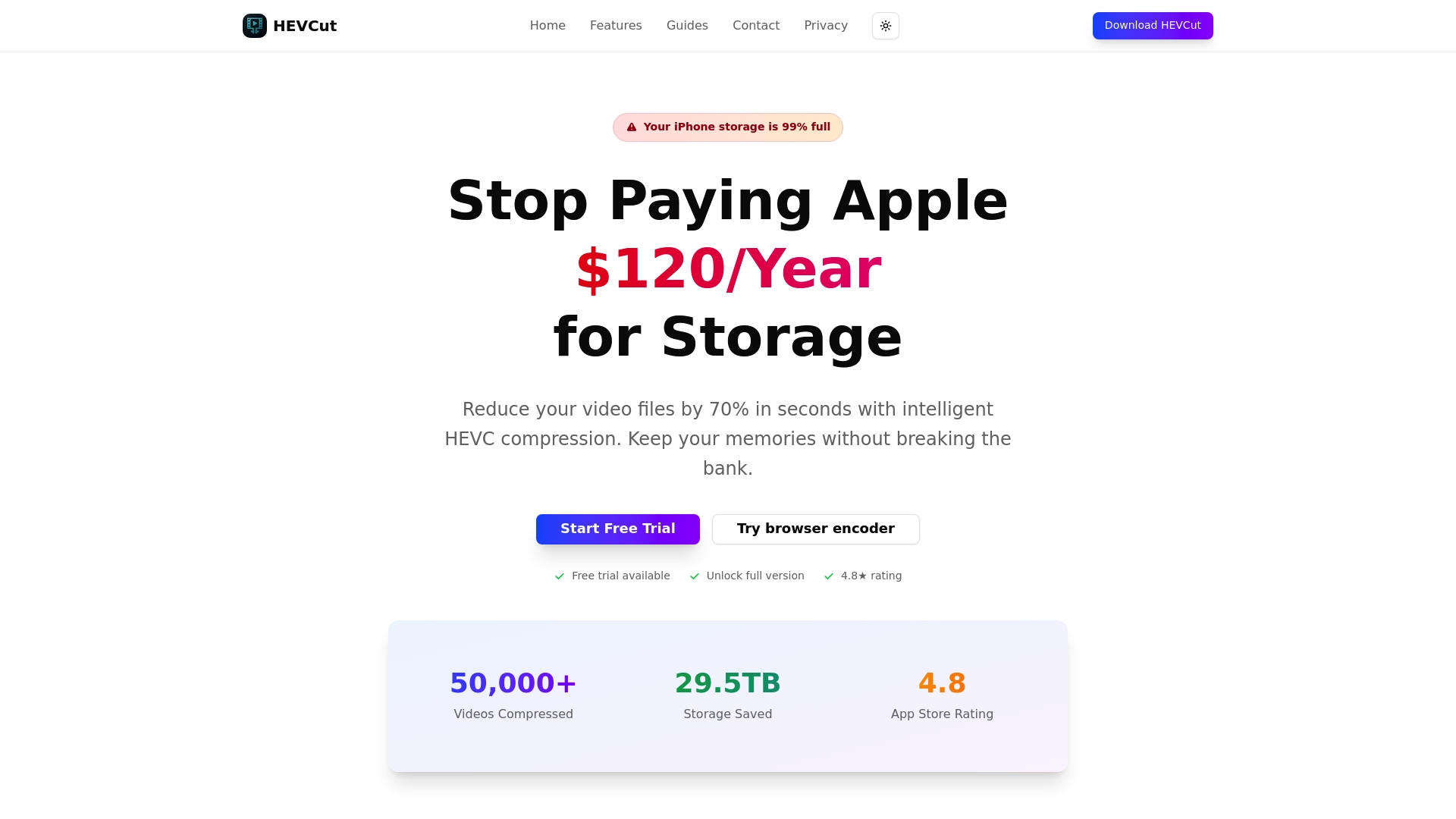
The platform's video compressor tool leverages advanced HEVC technology to shrink your video files by up to 70% while maintaining visual quality that satisfies even demanding clients. You simply upload your files, select your quality preferences, and let the system handle the technical complexity. Batch processing capabilities mean you can compress entire project folders overnight, reclaiming terabytes of storage space without babysitting the process.
Planning storage needs becomes straightforward with the video size calculator. Input your recording specifications (resolution, frame rate, codec, duration) and instantly see how much storage you'll need. This helps you budget accurately for upcoming projects and decide whether compression or additional storage makes more financial sense for your situation.
These tools work together to transform storage management from a constant expense into a solved problem. Compress your existing library to free up space immediately, then use the calculator to plan future storage needs with compression factored in. The combination helps you make smarter decisions about when to invest in new drives versus optimizing what you already have. Start managing your video files more efficiently and cut your storage costs today at HEVCut.
FAQ
What is the best video compression format for saving storage in 2026?
HEVC (H.265) is currently the most efficient compression codec widely supported for high-quality video storage savings. It delivers up to 70% smaller file sizes compared to older H.264 while maintaining equivalent visual quality. Most modern devices and editing software support HEVC playback and editing, making it practical for professional workflows. For maximum compatibility with older systems, H.264 remains viable but requires more storage space.
How can I balance video quality and storage savings effectively?
Start by testing compression at different quality levels on sample footage representative of your typical work. Use adjustable compression settings to find the sweet spot where file size drops significantly but quality remains acceptable for your audience and clients. HEVC excels at this balance, maintaining professional quality at much smaller file sizes than older codecs. Avoid over-compressing by always checking your output on the same displays your audience will use.
What are the best practices for backing up large video files efficiently?
Implement a hybrid backup strategy combining local and cloud solutions for both security and cost control. Efficient backup uses a combination of local and cloud solutions for reliability and cost control. Store one backup copy on a separate local drive and another in cloud storage or at a different physical location. Use incremental backups that only copy changed files to minimize storage usage and backup time. Regularly archive completed projects to cheaper storage tiers, moving them off expensive fast storage once active editing finishes.
How much can compression actually save on cloud storage costs?
Compression savings directly reduce cloud storage bills. If you're paying $50 monthly for 5TB and compress your library by 60%, you only need 2TB, dropping your bill to $20. That's $360 saved annually. Over five years, compression saves $1,800 in cloud fees alone. The savings multiply for larger libraries; a 10TB collection compressed by 60% saves $720 yearly. These reductions often exceed the cost of compression tools within the first few months.
Should I compress video files before or after editing?
Compress after editing is complete, not before. Edit with high-quality files (either original camera files or light compression) to maintain maximum flexibility for color grading, effects, and revisions. Once you finalize a project and export the master, compress both the master and project files for archival storage. This workflow preserves quality where it matters while achieving storage savings on completed work. Keep original camera files as archival masters and create compressed versions for distribution and everyday access.