
High-resolution video files are eating your storage alive. A single 4K shoot can fill a drive before you finish your coffee, and if your workflow isn't built to handle that scale, you're bleeding time and money every single week. This guide breaks down the most practical storage management strategies for content creators and small businesses, covering everything from tiered storage setups and backup rules to cloud cost control and next-gen compression. Whether you're managing a solo channel or a growing production team, these tactics will help you work faster and spend less.
Table of Contents
- Why smart storage management matters for video creators
- Core criteria for an efficient video storage workflow
- Top storage management strategies for high-res video
- Local drives vs NAS vs cloud: What fits your projects best?
- Controlling costs: Smart tactics for affordable storage
- Advanced tips and tricks: Future-proof your video storage
- Optimize your video storage workflow with HEVCut
- Frequently asked questions
Key Takeaways
| Point | Details |
|---|---|
| Tiered strategies save costs | Mixing fast local storage for active work and cloud for archives can cut long-term storage expenses by up to 87%. |
| Organization boosts productivity | Automating file structures and using metadata prevents hours wasted searching, letting you stay in your creative flow. |
| Test workflows to avoid fees | Cloud cold storage is cheap but can get expensive if accessed frequently; test your workflow to control costs. |
| Embrace backup best practices | The 3-2-1 rule shields your business from data loss and downtime. |
| Leverage compression & automation | Proxy editing, new video codecs, and automation tools can slash storage waste without harming video quality. |
Why smart storage management matters for video creators
Storage problems don't announce themselves. They creep up slowly until you're scrambling for space mid-project or paying for cloud upgrades you didn't plan for. The numbers make the stakes clear: 4K footage alone consumes 100 to 200GB per hour, and 8K pushes even harder at 36 to 38GB per hour. That's not a rounding error. That's a hard drive filling up in an afternoon.
Beyond raw file size, disorganization is its own tax. Creators lose 4.2 hours every week just searching for files without a proper organization system. Multiply that across a year and you've lost over 200 hours of productive time. For a small business, that's real money.
Here's what poor storage management actually costs you:
- Missed deadlines from slow drives or full disks mid-edit
- Duplicate files eating space because nothing is labeled correctly
- Unexpected cloud bills from unmanaged uploads and retrieval fees
- Lost footage from skipped backups or single-point storage failures
Good video file management tips aren't just about tidiness. They directly affect your bottom line and your creative output.
Core criteria for an efficient video storage workflow
Before you buy another drive or sign up for another cloud plan, you need a framework. Not every storage solution fits every workflow, and the wrong choice costs more in the long run.
Here are the criteria that matter most:
- Speed: Active editing needs fast local storage, NVMe SSDs ideally. Archive storage can be slower.
- Scalability: Your storage needs will grow. Build a system that expands without a full rebuild.
- Reliability: Drives fail. Services go down. Redundancy isn't optional.
- Backup and recovery: The 3-2-1 rule (three copies, two media types, one offsite) is the industry standard for a reason.
- Collaboration: Remote teams need cloud access. Solo creators may not. Match your setup to your actual workflow.
- Total cost of ownership: Don't just look at the monthly price. Factor in retrieval fees, hardware lifespan, and upgrade costs.
A tiered storage strategy is essential for cost optimization, meaning you keep hot files on fast local drives and cold files in cheaper long-term storage.

Pro Tip: Automate your folder structure with metadata rules from day one. Naming conventions like ProjectName_Date_Version eliminate the search problem entirely and take about 10 minutes to set up.
Building a cost-effective video workflow starts with these criteria, not with the gear.
Top storage management strategies for high-res video
Once you have your criteria, you need a strategy. Here are the four core approaches that work for creators and small businesses at scale.
-
Tiered storage: Keep your active project files on fast local NVMe or NAS drives. Move completed projects to cold cloud storage. This hybrid approach can cut storage costs by 40 to 87% compared to keeping everything on premium storage.
-
Hybrid workflows: Local storage handles the speed-sensitive editing work. Cloud handles the archive. You get the best of both without paying premium prices for everything.
-
Proxy editing: Instead of editing raw 4K or 8K files directly, you create lower-resolution proxy files for editing and reconnect to the originals for final export. This is standard practice for managing large footage volumes and dramatically reduces the strain on your drives and CPU.
-
The 3-2-1 backup rule: Three copies of every important file, stored on two different types of media, with one copy offsite. This protects you from hardware failure, theft, and disasters simultaneously.
Pro Tip: Schedule a monthly cleanup script or manual audit. Delete render caches, duplicate exports, and abandoned project files. Most creators free up 10 to 20% of their storage in the first audit alone.
For more detail on each of these, the cost-saving storage tips guide and the video content organization checklist are worth bookmarking.
Local drives vs NAS vs cloud: What fits your projects best?
Choosing the right storage hardware or service depends on your team size, budget, and how often you access your files. Here's a direct comparison.
| Storage type | Speed | Cost | Collaboration | Best for |
|---|---|---|---|---|
| Local SSD | Very fast | Medium upfront | Limited | Active editing |
| NAS | Fast (100MB/s+) | Low long-term | Team-friendly | Small team workflows |
| Cloud (hot) | Internet-bound | High ongoing | Excellent | Remote teams |
| Cloud (cold) | Slow retrieval | Very low | Limited | Long-term archive |
NAS (Network Attached Storage, a shared drive connected to your local network) is often the most cost-effective option for small teams. A NAS setup runs $400 to $1,000 for 10TB upfront, which becomes cheaper than cloud storage after just one to two years of use. Cloud storage makes more sense when you have under 4TB or when your team is fully remote.
For speed, NAS delivers 100MB/s or more on a local network, while cloud speed is entirely dependent on your internet connection. For video editing, that difference is significant.
Hybrid setups consistently outperform single-solution approaches for video workflows. Fast local storage for editing, cloud cold storage for archives, and NAS for team collaboration is a combination that scales well without breaking budgets.
The step-by-step storage guide walks through how to build this kind of setup from scratch.
Controlling costs: Smart tactics for affordable storage
Storage costs are predictable if you manage them actively. The biggest mistakes creators make are storing everything in the same tier and ignoring retrieval fees.
Here's a quick look at cloud storage class pricing to illustrate the difference:
| Storage class | Cost per GB/month | Best use case |
|---|---|---|
| AWS S3 Standard | $0.023 | Active project files |
| AWS S3 Infrequent Access | ~$0.0125 | Completed projects |
| AWS S3 Glacier | ~$0.004 | Quarterly access archives |
| AWS S3 Glacier Deep Archive | $0.00099 | Long-term cold storage |
AWS Glacier Deep Archive costs 87% less than S3 Standard, which is a massive saving for footage you rarely touch. But there's a catch: frequent retrieval from cold tiers wipes out those savings fast. Test your access patterns before committing.
Practical cost-control tactics:
- Use lifecycle policies to automatically move files from hot to cold storage after 30 or 60 days
- Audit your cloud usage monthly to catch forgotten uploads and orphaned files
- Avoid egress fees by choosing cloud providers with generous or free data transfer policies
- Compress before uploading to reduce the volume of data you're paying to store
For a full breakdown of what to expect in 2026, the cloud storage costs guide and cost-saving storage strategies cover current pricing and provider comparisons in detail.
Advanced tips and tricks: Future-proof your video storage
Once your core workflow is solid, these advanced moves will keep you ahead of the curve as file sizes and project volumes grow.
- Adopt next-gen codecs: HEVC (H.265) can reduce file sizes by up to 50% compared to H.264 with the same visual quality. For 4K and HDR content, this is a game-changer for storage budgets.
- Use proxy workflows consistently: Proxy editing and transcoding using formats like ProRes or DNxHD lets you edit massive files smoothly, then reconnect to originals for export. Bitrate and frame rate optimization during transcoding can shrink files further.
- Automate file tagging: Use metadata fields for client name, project type, date, and status. This makes search instant and enables automated archiving rules.
- Watch AI-driven tools: Several platforms are rolling out AI-powered organization and deduplication tools in 2026 that can automatically tag, sort, and flag redundant files.
Pro Tip: Schedule a quarterly project audit. Delete render caches, old exports, and abandoned drafts. Most creators find they can reclaim 1 to 3TB per audit without losing anything they actually need.
For deeper reading, the advanced video compression guide and the storage optimization with HEVC article cover codec-level strategies in detail.
Optimize your video storage workflow with HEVCut
All the strategies above work even better when your source files are as lean as possible before they hit your drives or cloud. That's exactly where HEVCut comes in. By compressing your video files with HEVC (H.265) technology, you can reduce file sizes by up to 70% without visible quality loss, which means less storage purchased, lower cloud bills, and faster upload and transfer times across your entire workflow.
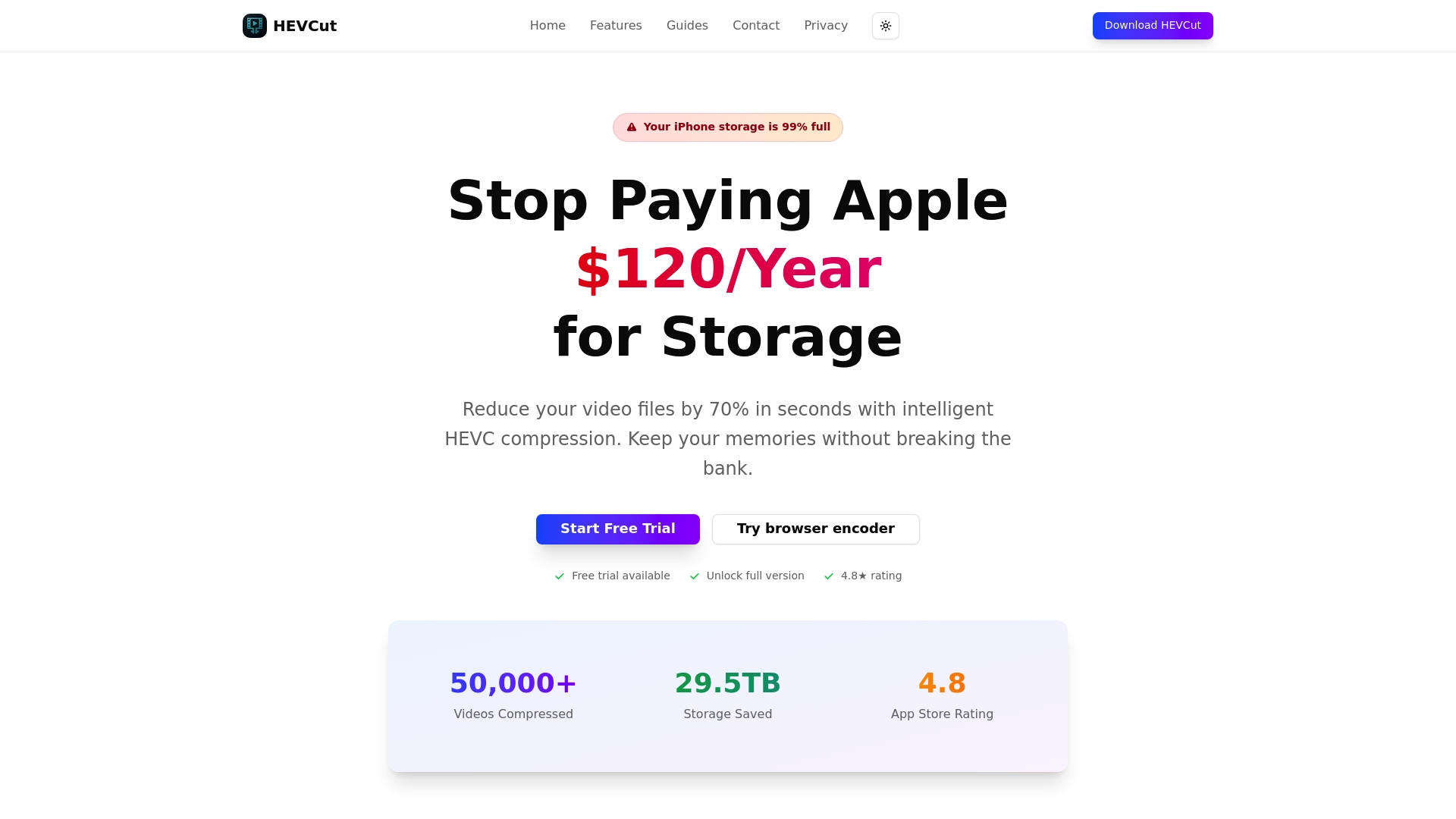
Start by using the video size calculator to get a personalized estimate of how much storage you could save on your current projects. From there, HEVCut's platform makes it easy to process files automatically or manually, so you can fit compression into your existing workflow without adding friction. Less storage pressure means more room to create.
Frequently asked questions
How much storage do I need for 4K and 8K video projects?
Plan for at least 2 to 4TB of fast local storage for active 4K editing, since one hour of 4K footage alone can consume 100 to 200GB. Archive storage needs will grow significantly over time.
What's the most cost-effective storage setup for small teams?
A hybrid setup combining fast local drives for active editing with cloud cold storage for archives cuts costs by 40 to 87% compared to keeping everything on premium storage tiers.
How do I avoid high retrieval fees in cloud storage?
Only move files to cold storage tiers if you access them rarely, and always test your workflow first, because frequent cold storage access eliminates the cost savings entirely.
What is the 3-2-1 backup rule for video files?
Keep three copies of every critical file, stored on two different types of media, with one copy stored offsite. This protects against hardware failure, accidental deletion, and physical disasters at the same time.
Can compression really save storage without sacrificing quality?
Yes. Proxy editing and transcoding combined with modern codecs like HEVC can dramatically shrink file sizes while keeping your footage fully editable and visually sharp through final export.