
Managing video files might seem simple until you realize that video resolutions grow so fast they are driving up storage needs at an exponential rate. Most people focus only on saving files or buying bigger drives, thinking that is the solution. In reality, smart video storage optimization can cut storage costs, speed up workflows, and unlock creative freedom you never knew you lost.
Table of Contents
- What is Video Storage Optimization and Why It Matters?
- The Importance of Efficient Video Storage in Content Creation
- Key Concepts of Video File Compression and Formats
- How Cloud and Local Storage Solutions Enhance Accessibility
- Real-World Applications of Video Storage Optimization Strategies
Quick Summary
| Takeaway | Explanation |
|---|---|
| Optimize video storage to save costs | Efficient storage reduces cloud expenses and hardware costs, essential for video-heavy operations. |
| Use advanced compression techniques | Intelligent compression retains video quality while minimizing file size, enhancing storage management. |
| Implement hybrid storage solutions | Combine local and cloud storage for flexibility, accessibility, and robust data backup. |
| Focus on sector-specific needs | Tailor storage strategies to the unique demands of various industries for optimal performance. |
| Streamline workflows for creativity | Efficient storage management frees up time and resources for content creation and innovation. |
What is Video Storage Optimization and Why It Matters?
Video storage optimization is a strategic approach to managing digital video files that minimizes storage requirements while preserving visual quality. The fundamental goal is to reduce file sizes without compromising the essential characteristics of the original recording. This technique becomes increasingly critical as video resolutions continue to expand and storage demands grow exponentially.
Understanding the Core Concept
At its essence, video storage optimization involves intelligent compression techniques that selectively reduce video file sizes. Unlike basic compression methods that can dramatically degrade image quality, advanced optimization strategies leverage sophisticated algorithms to maintain visual integrity. Learn more about efficient video compression techniques.
The process typically involves several key strategies:
- Removing redundant visual information
- Applying intelligent encoding algorithms
- Selecting appropriate video formats that balance quality and size
The Economic and Practical Implications
Video storage challenges extend far beyond simple file management. According to research from the National Institute of Standards and Technology, inefficient video storage can lead to significant operational costs and potential data loss. Professional content creators, businesses, and individual users alike face mounting challenges with exponential video data growth.
Key benefits of video storage optimization include:
- Reduced cloud storage expenses
- Faster file transfer speeds
- More efficient device storage utilization
- Enhanced backup and archival processes
By understanding and implementing video storage optimization techniques, users can transform their digital media management approach, saving time, money, and computational resources while maintaining high-quality visual content.
The Importance of Efficient Video Storage in Content Creation
Content creators today face unprecedented challenges in managing rapidly expanding video libraries. Digital content production has exploded, with professionals and hobbyists generating massive volumes of high resolution video that demand intelligent storage solutions. Discover smart backup strategies for content creators.
The Financial Impact of Storage Management
Unmanaged video storage can quickly become a significant financial burden. Professional videographers and content creators routinely generate terabytes of footage, with each hour of 4K video consuming approximately 50-100 gigabytes of storage. According to research from the Associated Press, efficient video management directly correlates with production efficiency and cost reduction.
Key financial considerations include:
- Direct storage hardware expenses
- Cloud storage subscription costs
- Potential data recovery expenses
- Time invested in managing unoptimized video files
Workflow Optimization and Creative Potential
Efficient video storage is not merely a technical requirement but a creative enabler. By implementing smart storage strategies, content creators unlock several transformative advantages:
- Faster project turnaround times
- Simplified video retrieval and archiving
- Reduced technical overhead
- Enhanced collaboration potential
Creative professionals can redirect resources previously spent on storage management toward actual content creation, innovation, and storytelling. The right storage optimization approach transforms technical constraints into opportunities for expanded creative expression.
Key Concepts of Video File Compression and Formats
Video file compression represents a sophisticated technological process of reducing digital video file sizes while maintaining visual quality. This complex mechanism allows users to store and transmit high quality video content more efficiently across various digital platforms. Learn about advanced video compression techniques.
Understanding Video Compression Fundamentals
At its core, video compression works by eliminating redundant visual information and encoding data more efficiently. According to research from the National Institutes of Health, compression algorithms analyze video frames and strategically remove unnecessary visual data without significantly degrading image quality.
Key compression strategies include:
- Spatial compression within individual frames
- Temporal compression across sequential frames
- Intelligent data encoding techniques
- Selective information retention
Video Format Landscape and Technical Considerations
Modern video formats represent complex ecosystems of compression technologies. Different formats offer unique advantages depending on specific use cases. H.264, HEVC (H.265), and VP9 are prominent examples, each presenting distinct characteristics in terms of compression efficiency, computational requirements, and compatibility.
Critical format selection factors encompass:
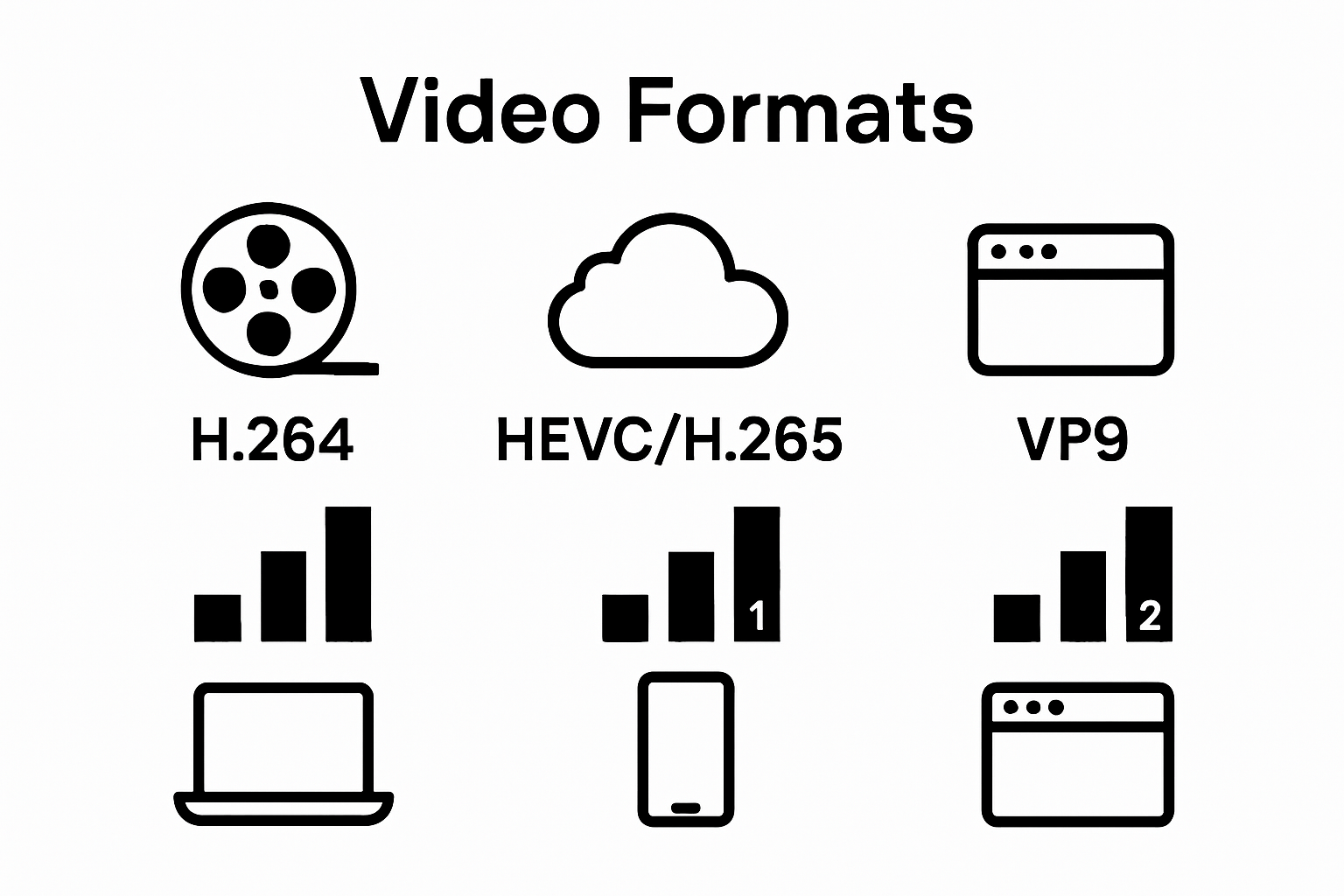
- Target device compatibility
- Required video quality
- Storage and bandwidth constraints
- Intended distribution platform
By understanding these fundamental concepts, users can make informed decisions about video storage optimization, balancing file size, visual quality, and technical performance across diverse digital environments.
Below is a table summarizing the main video file compression formats discussed in the article, highlighting their key characteristics for easy comparison.
| Compression Format | Compression Efficiency | Device Compatibility | Typical Use Cases |
|---|---|---|---|
| H.264 | Moderate | High | Online streaming, general editing |
| HEVC (H.265) | High | Moderate | 4K video, archival, modern devices |
| VP9 | High | Varies by platform | YouTube streaming, web distribution |
How Cloud and Local Storage Solutions Enhance Accessibility
Digital video storage has transformed from simple file preservation to a sophisticated ecosystem of interconnected solutions. Modern creators require flexible, secure, and intelligent storage strategies that seamlessly bridge local and cloud technologies. Explore efficient video backup strategies.
Understanding Storage Accessibility Dynamics
Storage accessibility represents more than just file availability. It encompasses the ability to retrieve, share, and manage video content efficiently across multiple devices and platforms. According to research from the National Center for Biotechnology Information, hybrid storage solutions offer unprecedented flexibility for multimedia management.
Key accessibility advantages include:
- Instant file retrieval across multiple devices
- Seamless synchronization between local and cloud platforms
- Enhanced collaboration potential
- Robust backup and redundancy mechanisms
Balancing Performance and Cost Effectiveness
Cloud and local storage are not competing technologies but complementary strategies. Local storage provides immediate access and complete control, while cloud solutions offer scalability and remote accessibility. Professional video creators can leverage both approaches to create a comprehensive storage ecosystem.
Critical considerations for hybrid storage include:
- Transfer speeds and bandwidth requirements
- Data security and encryption protocols
- Cost per gigabyte of storage
- Scalability and future expansion potential
By understanding and implementing intelligent storage strategies, users can transform their video management approach, ensuring maximum accessibility, security, and performance across their digital workflow.
Real-World Applications of Video Storage Optimization Strategies
Video storage optimization transcends theoretical concepts, delivering practical solutions across diverse professional and personal domains. From medical research to content creation, intelligent storage strategies revolutionize how we capture, store, and manage digital video content. Discover optimization strategies for content creators.
Innovative Sector-Specific Implementations
Different industries leverage video storage optimization uniquely to address specific challenges. According to research from Amrita Vishwa Vidyapeetham, advanced algorithms can dramatically reduce storage requirements without compromising critical monitoring capabilities.
Sector-specific optimization applications include:
- Medical imaging and telemedicine archival systems
- Security and surveillance infrastructure
- Scientific research and data collection
- Remote educational platforms
Performance and Economic Implications
Strategic video storage optimization delivers substantial economic and operational benefits. By implementing intelligent compression and intelligent retrieval mechanisms, organizations can significantly reduce infrastructure costs while improving overall system performance.
Key performance metrics demonstrate optimization advantages:
- Reduced hardware investment requirements
- Enhanced data transfer speeds
- Minimized cloud storage expenses
- Improved system responsiveness and accessibility
Understanding and implementing these strategies empowers users to transform video data management from a technical challenge into a strategic advantage across multiple professional domains.
The following table outlines how different industries apply video storage optimization, as referenced in the article, summarizing sector-specific strategies and practical benefits.
| Industry | Optimization Strategy | Key Benefits |
|---|---|---|
| Medical Imaging | Advanced compression for archival | Reduced storage, fast retrieval |
| Security/Surveillance | Algorithmic compression for monitoring | Lower costs, preserved critical detail |
| Scientific Research | Efficient data encoding and management | Improved accessibility, cost savings |
| Remote Education | Adaptive format selection for platforms | Better performance, scalable storage |

Unlock Effortless Video Storage Savings with HEVCut
Struggling to keep your videos organized without running out of storage? The article highlighted common frustrations with oversized files, slow backups, and high cloud costs. Whether you create content for fun or manage large video libraries for work, storage optimization is critical. Yet, traditional methods often mean sacrificing quality or investing in expensive upgrades. What if you could minimize file sizes and maintain pristine quality, just as discussed in the section on advanced compression techniques?
Try HEVCut.com today and experience next-level HEVC (H.265) compression. With our user-friendly platform, you can reduce video file sizes by up to 70 percent without visible loss in quality. You keep your 4K and HDR footage sharp and professional while gaining back valuable storage space. Ready to avoid the frustration of constant cloud upgrades? Start your free trial now and see the difference for yourself. For more tips and a deeper look at how our technology empowers smart storage, visit our latest guide on content creators’ storage strategies or explore useful video backup explanations. Take control of your video storage today!
Frequently Asked Questions
What is video storage optimization?
Video storage optimization is the strategic management of digital video files designed to minimize storage requirements while preserving visual quality through intelligent compression techniques.
Why is video storage optimization important for content creators?
Video storage optimization is crucial for content creators as it helps reduce storage expenses, enhances file transfer speeds, and improves device storage utilization, allowing more room for high-quality video content.
How can I optimize video file sizes without losing quality?
You can optimize video file sizes by using intelligent encoding algorithms, choosing appropriate video formats, and removing redundant visual information to maintain visual integrity while reducing file sizes.
What are the benefits of using both cloud and local storage for videos?
Using a hybrid storage approach combines the immediate access and control of local storage with the scalability and remote accessibility of cloud solutions, offering enhanced flexibility and security in video management.